

The Trajectory We Don't Teach: Compensation, Decompensation, and Irreversible Failure
August 25, 2026
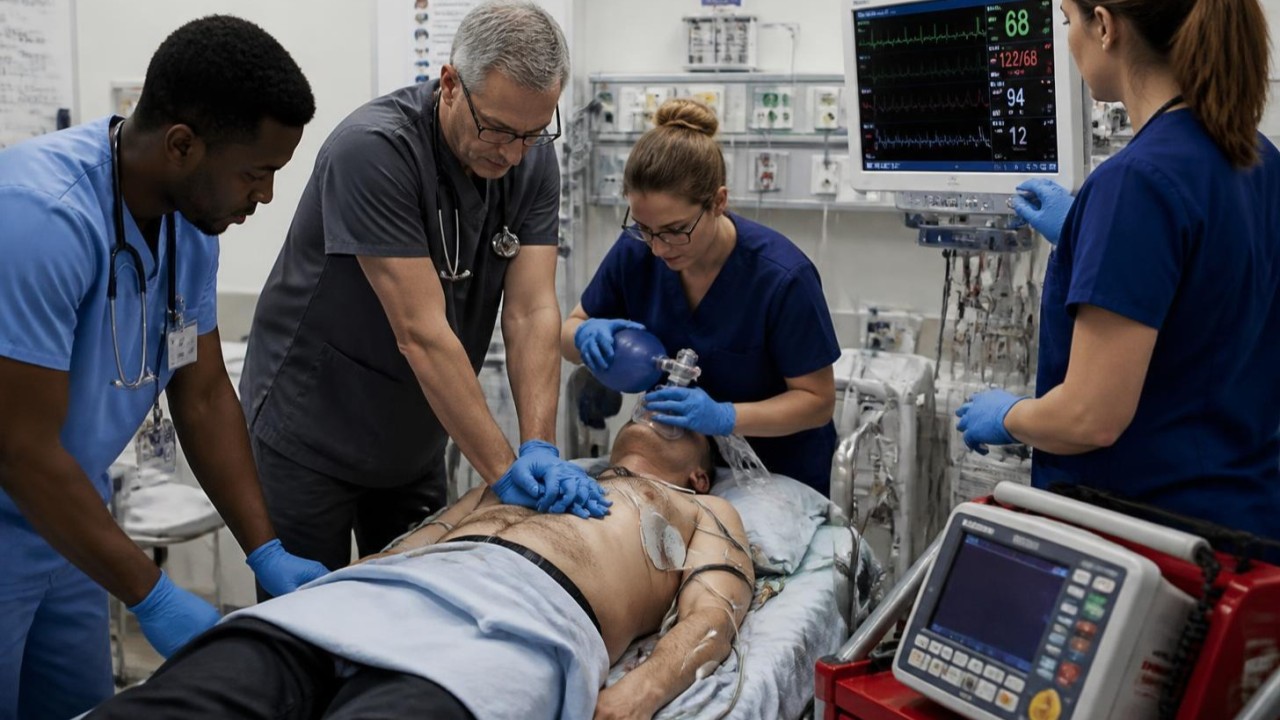
There is a moment in every preventable death when the patient was still savable.
Not savable in principle. Savable in fact, with the resources on hand, by the nurse already in the room, without a code team, without a transfer, without heroics. A moment when a small intervention would have been enough.
That moment has a name in physiology. It's called compensation. And it is almost entirely absent from how we teach nursing students to assess.
Three stages, and we teach the wrong one
Every patient who deteriorates moves through the same arc, regardless of the underlying cause. Sepsis, hemorrhage, heart failure, respiratory failure, the diagnoses differ, the trajectory does not.
Stage one: compensation. The body detects a problem and mobilizes against it. Heart rate climbs. Respiratory rate climbs. Peripheral vessels constrict, shunting blood away from skin, gut, and kidneys to protect the brain and heart. Urine output falls. Extremities cool. The patient may be restless, anxious, or simply "not quite right."
And the blood pressure is normal.
That last fact is the whole problem. During compensation the body succeeds, it maintains pressure and perfusion to vital organs by spending reserve it cannot replace. Hypotension is explicitly a late sign. A patient can lose roughly 30% of circulating volume before systolic pressure falls meaningfully. The number we train students to watch most closely is the number that moves last.
Stage two: decompensation. Compensation exhausts. Blood pressure falls. Mental status changes. Lactate climbs. Urine output stops. Skin mottles.
This stage is dramatic and unmistakable, and by the time it arrives you are no longer preventing an emergency. You are managing one.
Stage three: irreversible failure. Cellular injury passes the point of recovery. Organ systems fail in sequence. Intervention continues and outcome no longer responds to it. Patients in this stage still receive excellent care. They die despite our best resuscitation efforts, or they end up in our ICUs for days or weeks with poor long-term outcomes.
The window is in stage one. Our thresholds fire in stage two.
Here is the uncomfortable arithmetic of nursing education.
Compensation is where rescue is cheap: a phone call, a fluid bolus, an antibiotic, a set of eyes. Decompensation is where rescue is expensive and uncertain. Irreversible failure is where rescue is unavailable at any price.
Now look at what we actually teach students to act on. Blood pressure below 90. Oxygen saturation below 90%. Altered mental status. Every one of those thresholds sits in stage two.
We hand students a set of triggers calibrated to the stage where the window has already closed, then we ask why deterioration wasn't caught earlier.
This is also why 84% of patients who arrest on a general ward have documented deterioration in the preceding eight hours. The signs were there. They were in stage one, where our teaching provides no framework to interpret them and they were charted as isolated numbers rather than read as a trajectory.
Why body-system curricula cannot fix this
Most nursing programs organize physiology by system. Cardiovascular, respiratory, renal, neurologic, each taught separately, each with its own diseases.
But compensation is not a system. It is a whole-body response that crosses every system at once, and it presents in a characteristic order. Tachypnea before hypotension. Oliguria before altered mentation. Cool extremities before mottling. That sequence is the single most useful diagnostic tool a bedside nurse has, and a system-by-system curriculum has no place to put it.
A student who has studied each system in isolation must assemble the trajectory in real time, at the bedside, under pressure, having never once practiced the assembly. Some manage it. Some manage it after a patient dies.
Silber's original insight that hospitals with similar complication rates have very different mortality points at exactly this. Ghaferi and colleagues confirmed it: what separates the best hospitals from the worst is not how often complications occur but what happens next.
What happens next is decided in stage one.
What changes when you teach the arc
Teach compensation as a diagnosis in its own right, not as a set of borderline values.
Teach students to ask, of every abnormal finding: what is this body compensating for, and how long can it keep doing that? A heart rate of 112 is not a number to record. It is a body buying time, and the clinical question is what it is buying time for and how much it has left to spend.
Teach the sequence, so students recognize a trajectory rather than a snapshot. And teach them that a normal blood pressure in a patient who is tachypneic, oliguric, and cool is not reassurance. It is the sound of a system working hard and working hard is not the same as being fine.
Rescue is not a heroic act performed during a crisis. It is an ordinary act performed before one.
If this is how you want to teach, I built it already.
The Faculty Academy organizes physiologic concepts as trajectories of failure rather than as body systems with unfolding case studies, rubrics, and simulation tools designed to develop recognition rather than recall.
Take a look: https://lifebeatsolutions.com/membership
#NursingEducation #ClinicalJudgment #PatientSafety #NursingStudents #ClinicalDeterioration
FOLLOW US


Copyright 2025. All rights reserved
FOLLOW US
FOLLOW US
Copyright 2025. All rights reserved
The Trajectory We Don't Teach: Compensation, Decompensation, and Irreversible Failure
August 25, 2026
There is a moment in every preventable death when the patient was still savable.
Not savable in principle. Savable in fact, with the resources on hand, by the nurse already in the room, without a code team, without a transfer, without heroics. A moment when a small intervention would have been enough.
That moment has a name in physiology. It's called compensation. And it is almost entirely absent from how we teach nursing students to assess.
Three stages, and we teach the wrong one
Every patient who deteriorates moves through the same arc, regardless of the underlying cause. Sepsis, hemorrhage, heart failure, respiratory failure, the diagnoses differ, the trajectory does not.
Stage one: compensation. The body detects a problem and mobilizes against it. Heart rate climbs. Respiratory rate climbs. Peripheral vessels constrict, shunting blood away from skin, gut, and kidneys to protect the brain and heart. Urine output falls. Extremities cool. The patient may be restless, anxious, or simply "not quite right."
And the blood pressure is normal.
That last fact is the whole problem. During compensation the body succeeds, it maintains pressure and perfusion to vital organs by spending reserve it cannot replace. Hypotension is explicitly a late sign. A patient can lose roughly 30% of circulating volume before systolic pressure falls meaningfully. The number we train students to watch most closely is the number that moves last.
Stage two: decompensation. Compensation exhausts. Blood pressure falls. Mental status changes. Lactate climbs. Urine output stops. Skin mottles.
This stage is dramatic and unmistakable, and by the time it arrives you are no longer preventing an emergency. You are managing one.
Stage three: irreversible failure. Cellular injury passes the point of recovery. Organ systems fail in sequence. Intervention continues and outcome no longer responds to it. Patients in this stage still receive excellent care. They die despite our best resuscitation efforts, or they end up in our ICUs for days or weeks with poor long-term outcomes.
The window is in stage one. Our thresholds fire in stage two.
Here is the uncomfortable arithmetic of nursing education.
Compensation is where rescue is cheap: a phone call, a fluid bolus, an antibiotic, a set of eyes. Decompensation is where rescue is expensive and uncertain. Irreversible failure is where rescue is unavailable at any price.
Now look at what we actually teach students to act on. Blood pressure below 90. Oxygen saturation below 90%. Altered mental status. Every one of those thresholds sits in stage two.
We hand students a set of triggers calibrated to the stage where the window has already closed, then we ask why deterioration wasn't caught earlier.
This is also why 84% of patients who arrest on a general ward have documented deterioration in the preceding eight hours. The signs were there. They were in stage one, where our teaching provides no framework to interpret them and they were charted as isolated numbers rather than read as a trajectory.
Why body-system curricula cannot fix this
Most nursing programs organize physiology by system. Cardiovascular, respiratory, renal, neurologic, each taught separately, each with its own diseases.
But compensation is not a system. It is a whole-body response that crosses every system at once, and it presents in a characteristic order. Tachypnea before hypotension. Oliguria before altered mentation. Cool extremities before mottling. That sequence is the single most useful diagnostic tool a bedside nurse has, and a system-by-system curriculum has no place to put it.
A student who has studied each system in isolation must assemble the trajectory in real time, at the bedside, under pressure, having never once practiced the assembly. Some manage it. Some manage it after a patient dies.
Silber's original insight that hospitals with similar complication rates have very different mortality points at exactly this. Ghaferi and colleagues confirmed it: what separates the best hospitals from the worst is not how often complications occur but what happens next.
What happens next is decided in stage one.
What changes when you teach the arc
Teach compensation as a diagnosis in its own right, not as a set of borderline values.
Teach students to ask, of every abnormal finding: what is this body compensating for, and how long can it keep doing that? A heart rate of 112 is not a number to record. It is a body buying time, and the clinical question is what it is buying time for and how much it has left to spend.
Teach the sequence, so students recognize a trajectory rather than a snapshot. And teach them that a normal blood pressure in a patient who is tachypneic, oliguric, and cool is not reassurance. It is the sound of a system working hard and working hard is not the same as being fine.
Rescue is not a heroic act performed during a crisis. It is an ordinary act performed before one.
If this is how you want to teach, I built it already.
The Faculty Academy organizes physiologic concepts as trajectories of failure rather than as body systems with unfolding case studies, rubrics, and simulation tools designed to develop recognition rather than recall.
Take a look: https://lifebeatsolutions.com/membership
#NursingEducation #ClinicalJudgment #PatientSafety #NursingStudents #ClinicalDeterioration
Monitoring and Reporting
Collecting and analyzing data on safety incidents to identify trends and areas for improvement.
Establishing Standards
Developing and enforcing safety protocols to ensure consistency and quality across healthcare organizations.
Promoting Education
Providing training and resources to healthcare professionals to enhance their knowledge and skills in patient safety.
Encouraging Transparency
Creating a culture where healthcare workers feel empowered to report errors and near-misses without fear of retribution.

Driving Innovation
Leveraging technology and research to implement cutting-edge solutions for patient safety challenges.