

Task Completion Is Not the Same as Safe Nursing Practice
Date published: February 11, 2026
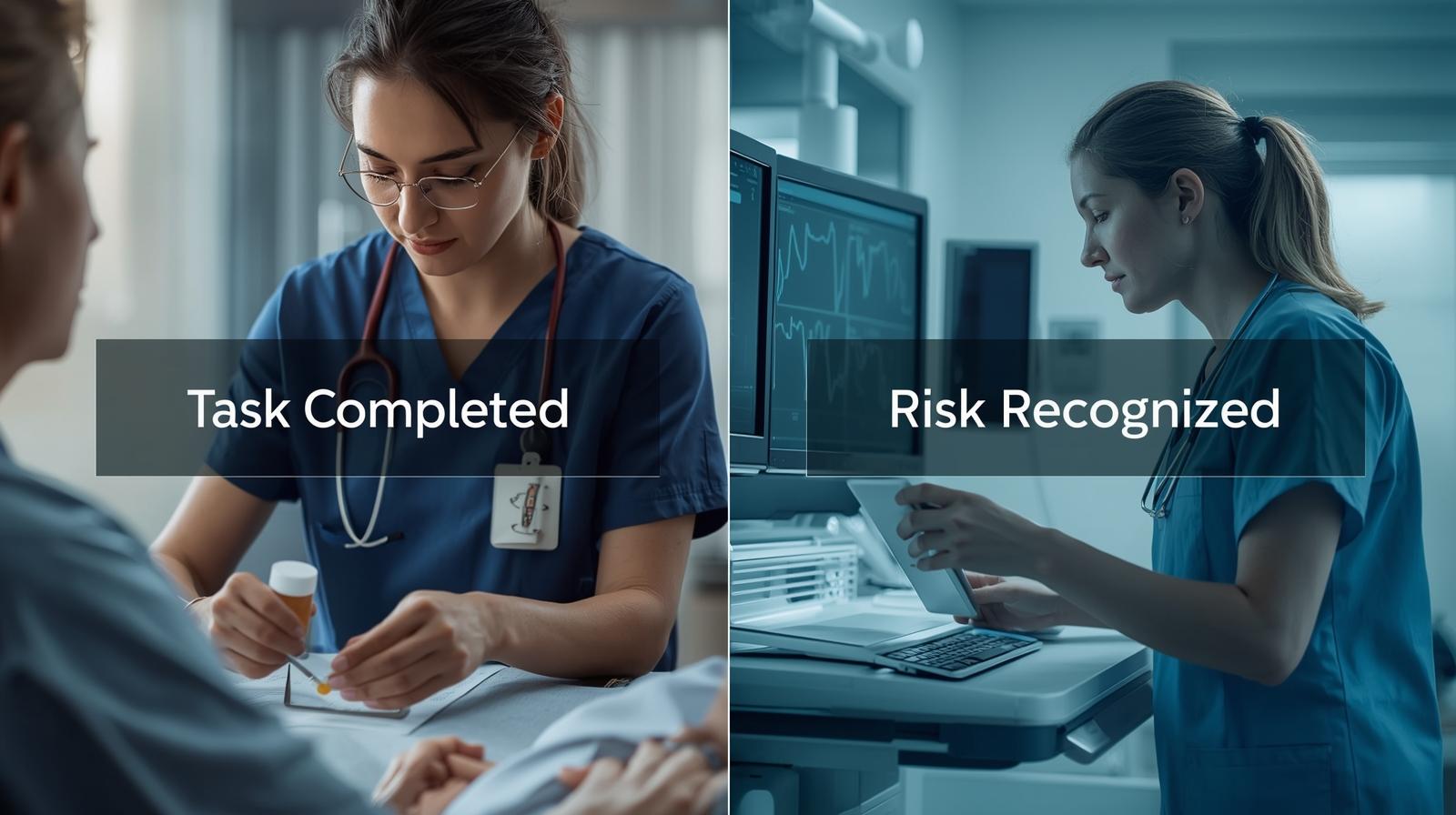
Why Clinical Judgment Must Be Taught—Not Assumed
Modern healthcare is very good at measuring whether tasks are completed.
We track medication administration, documentation compliance, checklist adherence, and time-to-task metrics with impressive precision.
And yet, patients continue to experience preventable harm.
The uncomfortable truth is this: task completion does not equal safe practice. The difference between the two lies in clinical judgment.
The Illusion of Safety Through Tasks
Nurses are trained extensively in skills—how to administer medications, how to follow protocols, how to document accurately. These competencies are essential, but they are not sufficient.
Consider this scenario:
Two nurses administer the same antihypertensive medication to similar patients.
Both verify the “five rights.”
Both document appropriately.
Only one nurse notices that the patient’s blood pressure has been trending downward over several hours, connects that trend to the medication’s mechanism of action, and reassesses before administering the dose. She contacts the provider and prevents hypotension and a rapid response.
Both nurses completed the task.
Only one practiced safely.
The difference was not caring, motivation, or diligence.
The difference was clinical judgment—the ability to interpret data, recognize risk, and anticipate consequences.
The Alarming Numbers Behind the Silence
For every serious medical error that reaches a patient, there are an estimated 300 near misses. That means for every fatal mistake, there are hundreds of unheeded warnings. It’s not because they don’t happen—it’s because we don’t hear about them.
Research consistently shows that only 10–20% of near misses and errors are ever reported. That’s an enormous blind spot.
Why is reporting so low? Common reasons include:
Fear of punishment or disciplinary action
Belief that “nothing bad happened, so it doesn’t matter”
Lack of time or overly complex reporting systems
Skepticism that reporting will lead to change
A culture that celebrates “catching errors” rather than preventing them
Each reason may seem reasonable in isolation. But together, they create a system where we ignore the very events that could help us prevent future harm.
Where Harm Really Happens
Patient harm rarely occurs because nurses do not know how to perform tasks. It occurs when clinicians fail to recognize what changes mean, when to escalate, or what risk is developing in real time.
This aligns with decades of patient safety research showing that adverse events are more often related to failures in recognition and response, rather than technical skill alone. The Institute of Medicine’s landmark report To Err Is Human highlighted that system failures—including inadequate training and poor decision-making support—are central contributors to preventable harm (Institute of Medicine, 2000). We find this to be still applicable today – systems failures continue to occur in many healthcare organizations.
In other words, harm happens in the space between tasks.
Clinical Judgment Is a Cognitive Skill
Clinical judgment is not intuition. It is not instinct. And it is not something nurses simply “pick up” with time.
It is a cognitive process that includes:
• Pattern recognition
• Risk prioritization
• Anticipation of deterioration
• Decision-making under uncertainty
These skills require structured education, repeated practice, and feedback in realistic clinical contexts.
Patricia Benner’s Novice to Expert framework makes this clear: novice nurses rely heavily on rules and tasks, while expert nurses integrate situational awareness and clinical reasoning. Without intentional education, nurses may remain task-focused far longer than patients can afford (Benner, 1984).
A Common Missed Opportunity
Take this common postoperative scenario:
A patient reports increasing pain four hours after surgery. Vital signs are within normal limits. The nurse documents pain and administers ordered analgesia.
A task-focused approach stops there.
A judgment-focused approach asks:
• Is this pain proportional to the procedure?
• Could this represent bleeding, compartment syndrome, or ischemia?
• Is opioid-related respiratory depression a concern?
When nurses are not trained to think this way, subtle but dangerous changes are missed—not because of negligence, but because the education system emphasized task completion over clinical reasoning.
Why New Nurses Struggle
Many new nurses are labeled “not ready” or “lacking confidence.” In reality, they are often placed in environments that demand advanced clinical judgment without providing the education to support it.
Research shows that new graduates frequently report feeling unprepared to manage patient deterioration, despite being technically competent (Kavanagh & Szweda, 2017). This gap places both patients and nurses at risk, contributing to burnout, moral distress, and turnover.
Expecting judgment without teaching it is not a workforce problem—it is an education design problem.
Education as a Safety Strategy
Organizations often invest heavily in technology to improve safety, yet underinvest in nursing education beyond onboarding. This is a costly mistake.
The Agency for Healthcare Research and Quality (AHRQ) consistently identifies early recognition and escalation as critical components of patient safety. Nurses are central to this process—but only if they are equipped to interpret clinical signals and act decisively.
Education that emphasizes clinical judgment:
• Reduces failure-to-rescue events
• Improves escalation and communication
• Strengthens team decision-making
• Protects patients before crises occur
This makes nursing education not an expense, but a high-impact safety intervention.
Moving Forward
If healthcare organizations truly want safer outcomes, they must stop equating completed tasks with competent care.
We must ask harder questions:
• Are nurses being taught how to think, not just what to do?
• Are education programs prioritizing judgment under pressure?
• Are systems rewarding speaking up and early escalation?
Clinical judgment is not optional.
It is not innate.
And it does not develop by accident.
It must be intentionally taught, practiced, and supported—because patients don’t get harmed by unfinished tasks nearly as often as they get harmed by missed meaning.
Where Lifebeat Solutions Fits
If we accept that task completion alone does not keep patients safe, then we must also accept that clinical judgment cannot be left to chance.
This is the gap Lifebeat Solutions was created to address.
Lifebeat Solutions focuses on intentional, structured education that strengthens nurses’ clinical judgment—not just their technical skills. Through case-based learning, real-world scenarios, and guided decision-making, nurses learn how to recognize subtle deterioration, connect clinical data to risk, and act with confidence before harm occurs.
The goal is not to replace experience, but to accelerate it safely.
By teaching nurses how to think under pressure—how to interpret trends, anticipate complications, and escalate early—Lifebeat Solutions supports the kind of practice that prevents failure-to-rescue events, reduces avoidable harm, and strengthens the nursing workforce.
Safer care doesn’t happen because tasks are checked off.
It happens when nurses are educated, supported, and trusted to exercise sound clinical judgment.
And that is where meaningful change begins.
For organizations committed to safer care, investing in clinical judgment education is not optional—it is foundational. The future of patient safety depends on how well we prepare nurses to think, not just to do.
Visit our website https://drjuliesiemers.com/lifebeat-solutions/ and book a consultation with us. For inquiries, you can also reach out via email at [email protected].
References
• Institute of Medicine. (2000). To Err Is Human: Building a Safer Health System. National Academies Press.
• Benner, P. (1984). From Novice to Expert: Excellence and Power in Clinical Nursing Practice. Addison-Wesley.
• Kavanagh, J. M., & Szweda, C. (2017). A crisis in competency: The strategic and ethical imperative to assessing new graduate nurses’ clinical reasoning. Nursing Education Perspectives, 38(2), 57–62.
• Agency for Healthcare Research and Quality (AHRQ). Patient Safety and Failure to Rescue resources.
#healthcare #nurse #nursing #nurselife #nursingeducation
Task Completion Is Not the Same as Safe Nursing Practice
Date published: February 11, 2026
Why Clinical Judgment Must Be Taught—Not Assumed
Modern healthcare is very good at measuring whether tasks are completed. We track medication administration, documentation compliance, checklist adherence, and time-to-task metrics with impressive precision.
And yet, patients continue to experience preventable harm.
The uncomfortable truth is this: task completion does not equal safe practice. The difference between the two lies in clinical judgment.
The Illusion of Safety Through Tasks
Nurses are trained extensively in skills—how to administer medications, how to follow protocols, how to document accurately. These competencies are essential, but they are not sufficient.
Consider this scenario:
Two nurses administer the same antihypertensive medication to similar patients.
Both verify the “five rights.”
Both document appropriately.
Only one nurse notices that the patient’s blood pressure has been trending downward over several hours, connects that trend to the medication’s mechanism of action, and reassesses before administering the dose. She contacts the provider and prevents hypotension and a rapid response.
Both nurses completed the task.
Only one practiced safely.
The difference was not caring, motivation, or diligence.
The difference was clinical judgment—the ability to interpret data, recognize risk, and anticipate consequences.
Where Harm Really Happens
Patient harm rarely occurs because nurses do not know how to perform tasks. It occurs when clinicians fail to recognize what changes mean, when to escalate, or what risk is developing in real time.
This aligns with decades of patient safety research showing that adverse events are more often related to failures in recognition and response, rather than technical skill alone. The Institute of Medicine’s landmark report To Err Is Human highlighted that system failures—including inadequate training and poor decision-making support—are central contributors to preventable harm (Institute of Medicine, 2000). We find this to be still applicable today – systems failures continue to occur in many healthcare organizations.
In other words, harm happens in the space between tasks.
Clinical Judgment Is a Cognitive Skill
Clinical judgment is not intuition. It is not instinct. And it is not something nurses simply “pick up” with time.
It is a cognitive process that includes:
• Pattern recognition
• Risk prioritization
• Anticipation of deterioration
• Decision-making under uncertainty
These skills require structured education, repeated practice, and feedback in realistic clinical contexts.
Patricia Benner’s Novice to Expert framework makes this clear: novice nurses rely heavily on rules and tasks, while expert nurses integrate situational awareness and clinical reasoning. Without intentional education, nurses may remain task-focused far longer than patients can afford (Benner, 1984).
A Common Missed Opportunity
Take this common postoperative scenario:
A patient reports increasing pain four hours after surgery. Vital signs are within normal limits. The nurse documents pain and administers ordered analgesia.
A task-focused approach stops there.
A judgment-focused approach asks:
• Is this pain proportional to the procedure?
• Could this represent bleeding, compartment syndrome, or ischemia?
• Is opioid-related respiratory depression a concern?
When nurses are not trained to think this way, subtle but dangerous changes are missed—not because of negligence, but because the education system emphasized task completion over clinical reasoning
Why New Nurses Struggle
Many new nurses are labeled “not ready” or “lacking confidence.” In reality, they are often placed in environments that demand advanced clinical judgment without providing the education to support it.
Research shows that new graduates frequently report feeling unprepared to manage patient deterioration, despite being technically competent (Kavanagh & Szweda, 2017). This gap places both patients and nurses at risk, contributing to burnout, moral distress, and turnover.
Expecting judgment without teaching it is not a workforce problem—it is an education design problem
Education as a Safety Strategy
Organizations often invest heavily in technology to improve safety, yet underinvest in nursing education beyond onboarding. This is a costly mistake.
The Agency for Healthcare Research and Quality (AHRQ) consistently identifies early recognition and escalation as critical components of patient safety. Nurses are central to this process—but only if they are equipped to interpret clinical signals and act decisively.
Education that emphasizes clinical judgment:
• Reduces failure-to-rescue events
• Improves escalation and communication
• Strengthens team decision-making
• Protects patients before crises occur
This makes nursing education not an expense, but a high-impact safety intervention.
Moving Forward
If healthcare organizations truly want safer outcomes, they must stop equating completed tasks with competent care.
We must ask harder questions:
• Are nurses being taught how to think, not just what to do?
• Are education programs prioritizing judgment under pressure?
• Are systems rewarding speaking up and early escalation?
Clinical judgment is not optional.
It is not innate.
And it does not develop by accident.
It must be intentionally taught, practiced, and supported—because patients don’t get harmed by unfinished tasks nearly as often as they get harmed by missed meaning.
Where Lifebeat Solutions Fits
If we accept that task completion alone does not keep patients safe, then we must also accept that clinical judgment cannot be left to chance.
This is the gap Lifebeat Solutions was created to address.
Lifebeat Solutions focuses on intentional, structured education that strengthens nurses’ clinical judgment—not just their technical skills. Through case-based learning, real-world scenarios, and guided decision-making, nurses learn how to recognize subtle deterioration, connect clinical data to risk, and act with confidence before harm occurs.
The goal is not to replace experience, but to accelerate it safely.
By teaching nurses how to think under pressure—how to interpret trends, anticipate complications, and escalate early—Lifebeat Solutions supports the kind of practice that prevents failure-to-rescue events, reduces avoidable harm, and strengthens the nursing workforce.
Safer care doesn’t happen because tasks are checked off.
It happens when nurses are educated, supported, and trusted to exercise sound clinical judgment.
And that is where meaningful change begins.
For organizations committed to safer care, investing in clinical judgment education is not optional—it is foundational. The future of patient safety depends on how well we prepare nurses to think, not just to do.
Visit our website https://drjuliesiemers.com/lifebeat-solutions/ and book a consultation with us. For inquiries, you can also reach out via email at [email protected].
References
• Institute of Medicine. (2000). To Err Is Human: Building a Safer Health System. National Academies Press.
• Benner, P. (1984). From Novice to Expert: Excellence and Power in Clinical Nursing Practice. Addison-Wesley.
• Kavanagh, J. M., & Szweda, C. (2017). A crisis in competency: The strategic and ethical imperative to assessing new graduate nurses’ clinical reasoning. Nursing Education Perspectives, 38(2), 57–62.
• Agency for Healthcare Research and Quality (AHRQ). Patient Safety and Failure to Rescue resources.
#healthcare #nurse #nursing #nurselife #nursingeducation
Monitoring and Reporting
Collecting and analyzing data on safety incidents to identify trends and areas for improvement.
Establishing Standards
Developing and enforcing safety protocols to ensure consistency and quality across healthcare organizations.
Promoting Education
Providing training and resources to healthcare professionals to enhance their knowledge and skills in patient safety.
Encouraging Transparency
Creating a culture where healthcare workers feel empowered to report errors and near-misses without fear of retribution.

Driving Innovation
Leveraging technology and research to implement cutting-edge solutions for patient safety challenges.
FOLLOW US


Copyright 2025. All rights reserved
FOLLOW US
FOLLOW US