

Why Content Coverage Is Not the Same as Clinical Preparation
Date published: April 23, 2026
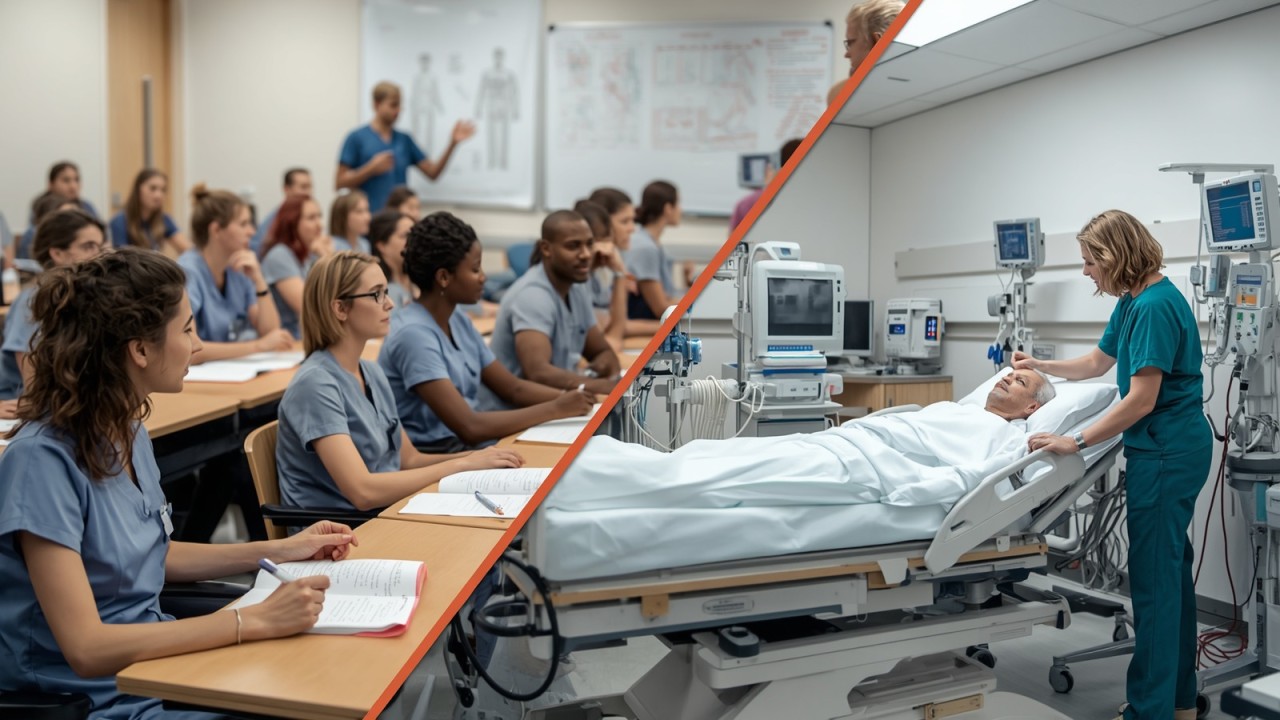
There is a finding from a 2023 study that should make every nurse educator pause. When preceptors at two major health systems were asked to assess newly graduated nurses using Lasater's clinical judgment rubric, new nurse graduates ranked lowest in their ability to identify significant clinical data and respond to challenging situations with calm, confident action. Kennedy, Laskowski & Breyman (2023)
Not pharmacology. Not anatomy. Not documentation. The two areas where new graduates fell shortest were recognizing what matters and acting decisively when it does.
Those are not content gaps. They are clinical judgment gaps. And they cannot be closed by covering more material.
The Assumption Built Into How We Teach
Most nursing curricula are designed around a deceptively reasonable premise: if students learn the right content, they will be able to use it at the bedside. Teach sepsis. Teach respiratory failure. Teach the signs of deterioration. Assume the application follows.
It doesn't — and the research is consistent on why. The theory-practice gap in nursing stems directly from the educational system's prioritization of theoretical aspects at the expense of practical elements, creating limitations in the knowledge students can actually apply in clinical settings. Singh et al. (2024) This isn't a new observation. It is a decades-old structural problem that the profession keeps identifying and insufficiently addressing.
What makes it particularly stubborn is that content-based teaching feels productive. Lectures get delivered. Exams get passed. NCLEX scores go up. The metrics look fine right up until a new graduate stands at the bedside of a patient whose respiratory rate has been quietly climbing for four hours — and doesn't act.
The Pedagogy Problem Nobody Wants to Name
Here is the part of this conversation that gets uncomfortable: the gap in new graduate readiness is not primarily a student problem. It is a faculty development problem.
Nurse educators are often recruited because of their experience and expertise in clinical areas — but they frequently bring limited or no experience in educational pedagogy. Simulation & theory-practice gap systematic review (2025) They know clinical practice. They do not always know how to engineer the specific cognitive experiences that build clinical judgment in learners. Those are different skill sets, and the profession has long assumed the first implies the second.
It does not. A nurse with thirty years of critical care experience can recognize a deteriorating patient from across the room. That same nurse, standing at the front of a classroom, may still be teaching students to memorize the criteria for sepsis rather than training them to reason through ambiguous clinical data in real time. The expertise is real. The pedagogy is missing.
Bridging the gap between theoretical instruction and practical competence remains a central challenge in nursing education, with nursing students often struggling to transfer classroom-acquired knowledge into real-world clinical environments — resulting in decreased confidence, impaired decision-making, and compromised patient care. Becker's Hospital Review
This is the downstream consequence of teaching content without teaching thinking.
What Clinical Preparation Actually Requires
Clinical judgment is not a knowledge acquisition problem. It is a cognitive development problem. It requires students to practice reasoning under ambiguity — with incomplete data, under time pressure, in situations where the right answer is not obvious until you have already made a decision about it.
That kind of cognitive habit is built through deliberate, repeated practice. Case studies that withhold information and require students to act before the picture is complete. Simulations debriefed not for outcome but for thinking process. Classroom discussions that normalize uncertainty and reward the recognition of early, subtle signals — not just the ones that have already declared themselves.
The formation of the International Consortium for Outcomes of Nursing Education in 2022 — a collective of nursing leaders specifically formed to address the academic-practice gap through high-quality, multi-site research — reflects how seriously the profession is now taking this problem. NCBI The Next Generation NCLEX was built on the same recognition. Measuring clinical judgment on the licensure exam is an important step. But the exam measures what education produces. If the education doesn't change, the outcomes won't either.
The Faculty Development Imperative
The solution is not more content. It is transformed pedagogy — and transformed pedagogy requires faculty who have been trained to deliver it.
This is precisely what the Clinical Judgment & Safety Method™ Faculty Academy was built to address. Not because faculty are failing, but because they have never been given the specific tools to teach clinical reasoning as a skill rather than assume it as a byproduct of content coverage. The distinction matters enormously: a faculty member who understands how clinical judgment develops — and how to build the cases, the simulations, and the debriefs that accelerate it — produces fundamentally different graduates than one who covers the same material without that framework.
The 2023 Kennedy study didn't find that new graduates lacked knowledge. It found they couldn't identify what was significant and couldn't respond with confidence when it mattered. Those are teachable skills. They are just not being systematically taught.
That is the gap. And closing it starts with faculty.
Visit our website https://drjuliesiemers.com/lifebeat-solutions/ and book a consultation with us. For inquiries, you can also reach out via email at [email protected].
Dr. Julie Siemers, DNP, RN, is the founder of Lifebeat Solutions and creator of the Patient Safety Standard™ curriculum, with 46 years of clinical and nursing education leadership experience and doctoral research focused on failure-to-rescue prevention
Three research links to embed:
Kennedy, Laskowski & Breyman (2023) — Clinical judgment gaps in new graduates: https://pubmed.ncbi.nlm.nih.gov/38117907/
Singh et al. (2024) — Theory-practice gap systematic review: https://doi.org/10.1155/2024/7522900
Simulation & theory-practice gap systematic review (2025): https://pmc.ncbi.nlm.nih.gov/articles/PMC12392514/
#ClinicalJudgment #NursingEducation #PatientSafety #NurseEducators #HealthcareEducation
Why Content Coverage Is Not the Same as Clinical Preparation
Date published: April 23, 2026
There is a finding from a 2023 study that should make every nurse educator pause. When preceptors at two major health systems were asked to assess newly graduated nurses using Lasater's clinical judgment rubric, new nurse graduates ranked lowest in their ability to identify significant clinical data and respond to challenging situations with calm, confident action. Kennedy, Laskowski & Breyman (2023)
Not pharmacology. Not anatomy. Not documentation. The two areas where new graduates fell shortest were recognizing what matters and acting decisively when it does.
Those are not content gaps. They are clinical judgment gaps. And they cannot be closed by covering more material.
The Assumption Built Into How We Teach
Most nursing curricula are designed around a deceptively reasonable premise: if students learn the right content, they will be able to use it at the bedside. Teach sepsis. Teach respiratory failure. Teach the signs of deterioration. Assume the application follows.
It doesn't — and the research is consistent on why. The theory-practice gap in nursing stems directly from the educational system's prioritization of theoretical aspects at the expense of practical elements, creating limitations in the knowledge students can actually apply in clinical settings. Singh et al. (2024) This isn't a new observation. It is a decades-old structural problem that the profession keeps identifying and insufficiently addressing.
What makes it particularly stubborn is that content-based teaching feels productive. Lectures get delivered. Exams get passed. NCLEX scores go up. The metrics look fine right up until a new graduate stands at the bedside of a patient whose respiratory rate has been quietly climbing for four hours — and doesn't act.
The Pedagogy Problem Nobody Wants to Name
Here is the part of this conversation that gets uncomfortable: the gap in new graduate readiness is not primarily a student problem. It is a faculty development problem.
Nurse educators are often recruited because of their experience and expertise in clinical areas — but they frequently bring limited or no experience in educational pedagogy. Simulation & theory-practice gap systematic review (2025) They know clinical practice. They do not always know how to engineer the specific cognitive experiences that build clinical judgment in learners. Those are different skill sets, and the profession has long assumed the first implies the second.
It does not. A nurse with thirty years of critical care experience can recognize a deteriorating patient from across the room. That same nurse, standing at the front of a classroom, may still be teaching students to memorize the criteria for sepsis rather than training them to reason through ambiguous clinical data in real time. The expertise is real. The pedagogy is missing.
Bridging the gap between theoretical instruction and practical competence remains a central challenge in nursing education, with nursing students often struggling to transfer classroom-acquired knowledge into real-world clinical environments — resulting in decreased confidence, impaired decision-making, and compromised patient care. Becker's Hospital Review
This is the downstream consequence of teaching content without teaching thinking.
What Clinical Preparation Actually Requires
Clinical judgment is not a knowledge acquisition problem. It is a cognitive development problem. It requires students to practice reasoning under ambiguity — with incomplete data, under time pressure, in situations where the right answer is not obvious until you have already made a decision about it.
That kind of cognitive habit is built through deliberate, repeated practice. Case studies that withhold information and require students to act before the picture is complete. Simulations debriefed not for outcome but for thinking process. Classroom discussions that normalize uncertainty and reward the recognition of early, subtle signals — not just the ones that have already declared themselves.
The formation of the International Consortium for Outcomes of Nursing Education in 2022 — a collective of nursing leaders specifically formed to address the academic-practice gap through high-quality, multi-site research — reflects how seriously the profession is now taking this problem. NCBI The Next Generation NCLEX was built on the same recognition. Measuring clinical judgment on the licensure exam is an important step. But the exam measures what education produces. If the education doesn't change, the outcomes won't either.
The Faculty Development Imperative
The solution is not more content. It is transformed pedagogy — and transformed pedagogy requires faculty who have been trained to deliver it.
This is precisely what the Clinical Judgment & Safety Method™ Faculty Academy was built to address. Not because faculty are failing, but because they have never been given the specific tools to teach clinical reasoning as a skill rather than assume it as a byproduct of content coverage. The distinction matters enormously: a faculty member who understands how clinical judgment develops — and how to build the cases, the simulations, and the debriefs that accelerate it — produces fundamentally different graduates than one who covers the same material without that framework.
The 2023 Kennedy study didn't find that new graduates lacked knowledge. It found they couldn't identify what was significant and couldn't respond with confidence when it mattered. Those are teachable skills. They are just not being systematically taught.
That is the gap. And closing it starts with faculty.
Visit our website https://drjuliesiemers.com/lifebeat-solutions/ and book a consultation with us. For inquiries, you can also reach out via email at [email protected].
Dr. Julie Siemers, DNP, RN, is the founder of Lifebeat Solutions and creator of the Patient Safety Standard™ curriculum, with 46 years of clinical and nursing education leadership experience and doctoral research focused on failure-to-rescue prevention
Three research links to embed:
Kennedy, Laskowski & Breyman (2023) — Clinical judgment gaps in new graduates: https://pubmed.ncbi.nlm.nih.gov/38117907/
Singh et al. (2024) — Theory-practice gap systematic review: https://doi.org/10.1155/2024/7522900
Simulation & theory-practice gap systematic review (2025): https://pmc.ncbi.nlm.nih.gov/articles/PMC12392514/
#ClinicalJudgment #NursingEducation #PatientSafety #NurseEducators #HealthcareEducation
Monitoring and Reporting
Collecting and analyzing data on safety incidents to identify trends and areas for improvement.
Establishing Standards
Developing and enforcing safety protocols to ensure consistency and quality across healthcare organizations.
Promoting Education
Providing training and resources to healthcare professionals to enhance their knowledge and skills in patient safety.
Encouraging Transparency
Creating a culture where healthcare workers feel empowered to report errors and near-misses without fear of retribution.

Driving Innovation
Leveraging technology and research to implement cutting-edge solutions for patient safety challenges.
FOLLOW US


Copyright 2025. All rights reserved
FOLLOW US
FOLLOW US